Koldheim · Morganite
Projects
Project managementWork in columns, on the same records.
Move a card, and the record moves with it, under your name.
Tickets on a board whose columns are a field, so moving a card writes that one field and lands on the trail with who moved it. A board shows yours or everyone’s, and a ticket can point at any other record.
The problem
“Work lives in people’s heads and a spreadsheet, and I cannot see what is in flight.”
What it runs
4 stepsWhat happens, in order
Every one of these is a step the service takes itself. Nothing in this list is somebody remembering to do it.
- What needs doing is captured, with its project, its priority and any screenshots or documents. Anyone on the team can add more while it is open, and a manager can take off one that was added by mistake.
- It goes to the backlog.
- Somebody triages it.
- If it has an assignee, that person is told. If it does not, it is parked.
It opens on a board
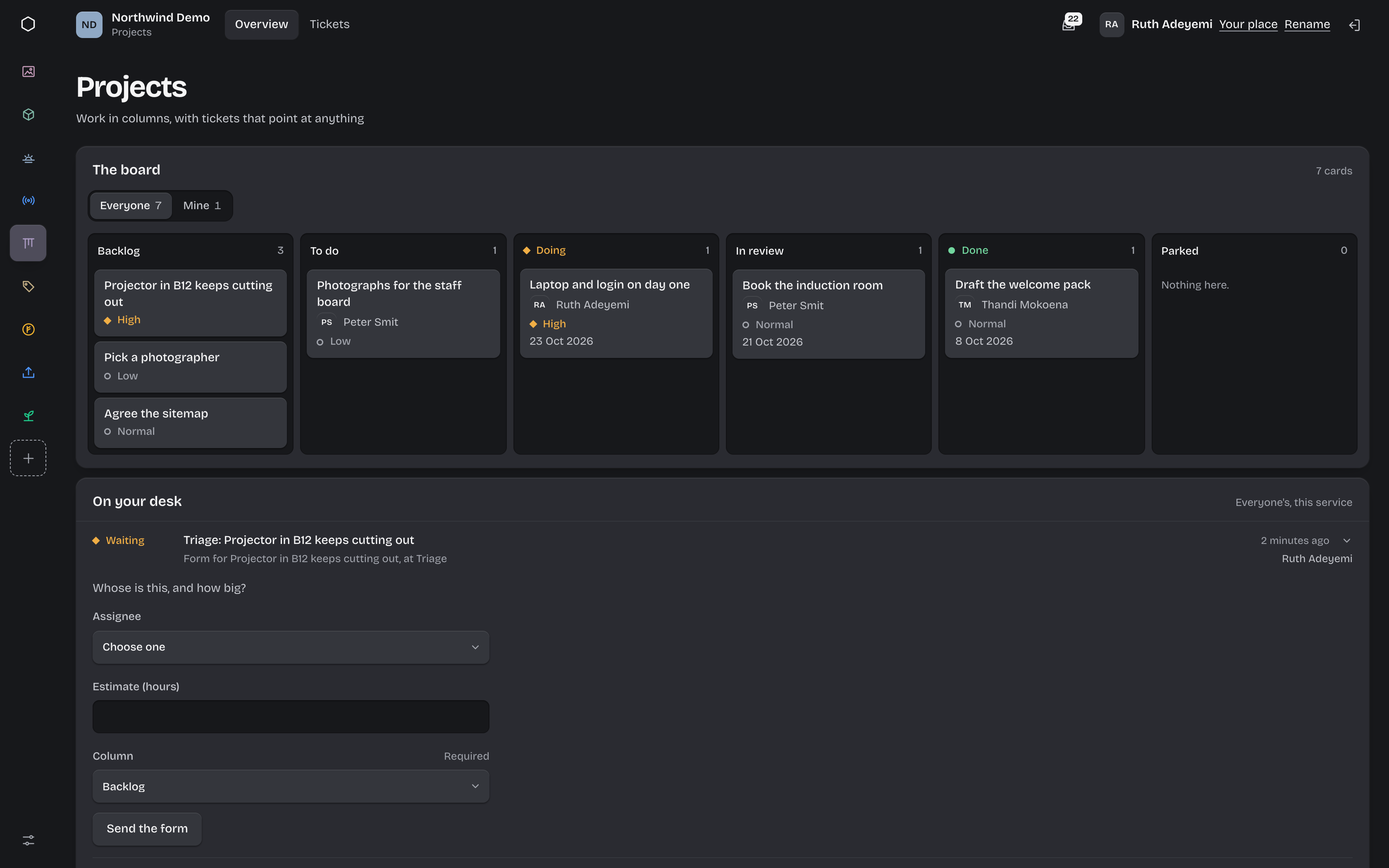
Projects is the one service that does not open on numbers. It opens on a board: tickets in columns, your own tasks, and a table of projects. There are no figures on it, and we are not going to pretend there are.
On screen
What it looks like
Captured from the product as it is, with the demo workspace's own records.
Try the rule
Raise a ticket. Watch where it lands.
Projects runs one process, and it is short: a project lead triages what comes in. With somebody named, they are told; with nobody, it is parked rather than lost.
To doAssigned, in To do
- Backlog
- To do
- Projector in room 4 flickers
- Doing
- In review
- Done
- Parked
- Raised"Projector in room 4 flickers", priority high, on a project, with any screenshots. Anyone can raise one.
- Into the backlogA record from this moment, not a draft, in the Backlog column.
- A project lead triages itWhose it is, and which column it goes to. Who holds project lead is yours.
- Somebody has itThe column is set to To do.
- They are told"Yours: Projector in room 4 flickers. It is in To do."
- Then the boardDragging the card writes that one column field, with who moved it on the trail. Not a process: it waits on nobody.
Who sets what
Yours to change, and ours
Most vendors are vague about this line. Yours is everything about how your organisation works. Ours is the shape of the process itself.
Your administrators change these
- Projects, and the columns on a board
- Priorities
- Who holds project lead
Authored with the service
- That a column is a field, so moving a card writes that one field
A change here is a draft, checked and published. Work already under way stays on the version it started on.
Where it stops
The part most pages leave out
A service that only ever says yes is not evidence. This is the place it deliberately refuses, and the suite that proves it still does.
Refuses, on purpose
Renaming something does not break the link
A ticket can point at any other record. The link is the record’s id, and the label you see is a cache of its name, so renaming what it points at does not leave a dangling reference.
Proof
Every claim here runs on each build
Not a policy, a suite. This one is npm run projects, and it fails the build rather than a report nobody reads.
The rest of the collection
One stone, many cuts
Keep exploring